Legal Record & Accountability Timeline

Support local residents working to protect Steele County neighborhoods and farmland,
promote transparency, and ensure public funds are spent responsibly and lawfully.
We need your help to ensure public decisions are made openly, fairly, and in accordance with the law.
Where We’re At Right Now
Over the past 4+ years residents have worked tirelessly to hold local governments accountable for the East Side Corridor project. Thanks to community support, we’ve reached a critical stage — and this fight is far from over.
Here’s where things stand now:
Residents Filed a Formal Appeal of the FOFC on March 12, 2026
Following Steele County's adoption of the FOFC, which determined that the proposed East Side Corridor did not have the potential for significant environmental effects despite constructing a highway within a substandard right-of-way as close as 17 feet from homes, residents retained environmental attorneys and filed an appeal with the Minnesota Court of Appeals on March 12, 2026.Case Number: A26-0468 (3/12/2026)
Residents Brief (6/10/2026)
County's Response Brief (7/10/2026)
Reply Brief (7/24/2026)
Key decisions and funding actions were taken before environmental review was complete.
Federal funds were advanced, mitigation was discussed, and the project moved forward during leadership transitions — all without meaningful public oversight— not becaue residents didn't ask.
Why Your Donations Matters
This project is now at the point where legal accountability is the only remaining mechanism to ensure compliance with environmental law, open meeting requirements, and public data access obligations.
Community donations are being used to:
Prepare for a EAW appeal and injunction
Obtain legal guidance on next steps
Address Data Practices Act and Open Meeting Law issues, including records access and compliance
Cover costs related to records, filings, expert review, and oversight referrals
Ensure residents — not just agencies and consultants — can be heard
Accountability isn’t free — but when a lot of people give a little, communities can push back against decisions made behind closed doors.
Real change begins when someone stands up for their rights. We are standing up for every resident’s right to be heard in local government.
Thank You
Every share, every donation, and every message of support has helped get us to this point. This effort has never been just about a road; it’s about transparency, safety, fairness, quality of life, and ensuring residents have a voice in decisions that shape our community.
We’re grateful for your continued support as we enter this next critical phase.
Legal Wins
MGDPA: A Significant Legal Victory for Transparency
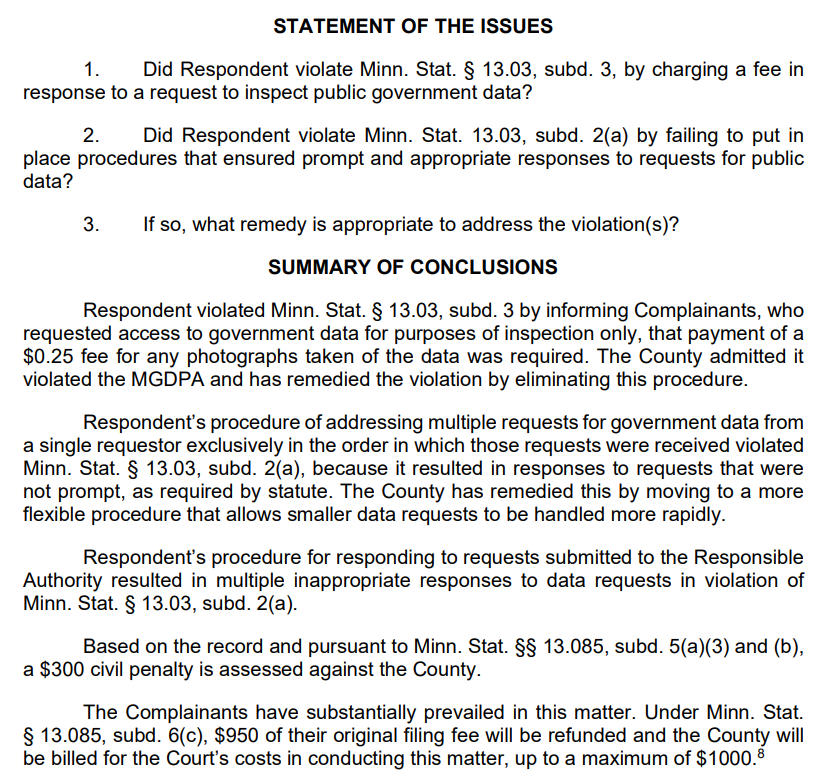
On November 24, 2025, an Administrative Law Judge ruled that East Side Corridor residents had substantially prevailed in their Minnesota Government Data Practices Act (MGDPA) case against Steele County.
Without legal counsel of their own, East Side Corridor residents represented themselves pro se against four attorneys representing Steele County. The Administrative Law Judge found repeated violations of two provisions of the Minnesota Government Data Practices Act—Minn. Stat. § 13.03, subd. 2(a), and § 13.03, subd. 3—throughout the County's handling of the residents' data requests and ordered Steele County to pay the maximum civil penalty allowed by law, refund filing costs, and improve its data request practices to be compliant with MGDPA
This ruling demonstrated that ordinary citizens, through careful research, persistence, and documentation, can successfully hold government accountable under Minnesota law.
Post-Ruling
Although residents substantially prevailed in the MGDPA proceeding, disputes over public records have continued. Requested records remain outstanding, some previously produced records have become unavailable or inaccessible, and the County continues to assert that certain requested data does not exist despite evidence that demonstrates otherwise.
How We Got Here: Key Legal and Procedural Milestones
July 14, 2026 – Steele County Approves Data Retention Policy to "Prevent Unwanted Data requests"
Four days after submitting its respondent's brief in the East Side Corridor appeal, Steele County approved a new digital data retention policy. During the Board meeting, County officials stated the purpose of the policy was to "prevent unwanted public data requests". Key provisions of the policy include:
Emails are scheduled for deletion after 14 months.
Instant messages are scheduled for deletion after 30 days.
* This policy change requires State Approval that has not been obtained as of this posting.*
May 26, 2026 – County Approves $1.78 Million WSB Final Design Contract Despite Preceived Conflicts of Interest
Before the meeting, residents submitted conflict-of-interest notices to the Steele County Board. The County Attorney responded that the Board had received legal advice and that, in his opinion, no conflicts of interest existed and "concerns are invalid". Watch here
Board approved a $1.78 million contract with WSB for final design of the East Side Corridor, just days after the administrative record was provided to the Minnesota Court of Appeals as part of the ongoing appeal.
Note: WSB previously received substantial funding for "final design work" through a May 13, 2025, contract amendment, raising questions about how the earlier and later design authorizations relate to one another.
February 10, 2026 – EIS Decision Published
Steele County's decision that an Environmental Impact Statement (EIS) was not required for the East Side Corridor project was published in the Minnesota Environmental Quality Board's (EQB) EQB Monitor, officially starting the deadline to appeal the decision.
January 27, 2026 – County Board Adopts FOFC
The Steele County Board of Commissioners adopted the Highway Department's Findings of Fact and Conclusions (FOFC) and determined that an Environmental Impact Statement (EIS) was not required for the East Side Corridor project. Residents showed up and spoke out.
January 22, 2026 – County Issues FOFC
The Steele County Highway Department issued its Findings of Fact and Conclusions (FOFC), determining that the Environmental Assessment Worksheet (EAW) was adequate and that an Environmental Impact Statement (EIS) was not required. The County also released written responses to public comments submitted during the EAW process. Many residents believed significant concerns were only briefly addressed or received similar responses despite raising different issues.
January 13, 2026 – Conflict-of-Interest Notices Submitted
Conflict-of-interest notices regarding the East Side Corridor were submitted to the Steele County Board of Commissioners before the final environmental decision. The notices raised concerns about potential conflicts and requested that they be considered as part of the decision-making process.
December 31, 2025 – Public Comment Period Closed
The public submitted substantial comments identifying missing impacts, procedural flaws, inconsistencies, data manipulation, outdated data, predetermination, segmentation, and other deficiencies in the EAW. We are aware of more than 200 comments submitted, totaling more than 1,500 pages.
**The files below reflect public EAW comments submitted to the RGU that were copied or forwarded to us by submitters during the comment period. Steele County has not yet released the complete official comment record; however, these submissions independently preserve a substantial portion of the public record.
Individual Public EAW Comments
Individual Comments – Part 1 (26MB PDF)
Individual Comments – Part 2 (29MB PDF)
Individual Comments – Part 3 (38MB PDF)
Organizational Public EAW Comments
Organizational Comments – Part 1 (27MB PDF)
Organizational Comments – Part 2 (36MB PDF)
Organizational Comments – Part 3 (34MB PDF)

Public Data: During the EAW comment period, Steele County produced only unusable email files converted into .txt files, large portions of previously provided emails going missing, and repeatedly missed stated deadlines for producing requested data. After the administrative ruling found the County in violation of the Minnesota Government Data Practices Act (MGDPA), no meaningful or usable data has been produced. Despite repeated requests, the County did not pause or extend the EAW comment period to allow residents access to public data necessary for meaningful participation and continued to deny the existence of noise studies later provided by the State.
December 11, 2025: ESC Public Open House
Hundreds of residents attended the public open house and submitted even more comments. Responses provided to attendees regarding the status and content of the EAW were inconsistent, including statements that the EAW was a draft, that the project was a “done deal,” that the project was described as “Project Destination,” and that avoidance remained an option to consider.
During the open house, the RGU was unable to clearly identify what analyses were included in the EAW and assured residents that noise studies were included, despite prior public data responses indicating such studies did not exist. The RGU was also unfamiliar with Alternative 3B and demonstrated uncertainty regarding the scope of the RGU role.
County administration stated that avoidance, minimization measures, MEPA- and NEPA-compliant noise mitigation, and condemnation would not be considered. Residents were nonetheless directed to submit comments selecting among landscaping options, despite those options not meeting applicable regulatory standards.
Early December 2025: Impacted residents were first notified of the public comment period more than two weeks after it began. During this time, the project website did not align with EQB records, provided limited comment submission options that created barriers to participation, and failed to list the public open house. Additionally, residents who requested written updates did not receive the EAW. The EQB intervened to clarify the public comment deadline and to ensure residents were able to submit comments meaningfully via email.
November 24, 2025 – Administrative Law Judge Issues Ruling
An Administrative Law Judge issued a ruling in the residents' Minnesota Government Data Practices Act case. East Side Corridor residents substantially prevailed, and Steele County was ordered to pay the maximum civil penalty allowed by law, along with other remedies.
November 18, 2025: Steele County released the EAW for public comment while a Minnesota Government Data Practices Act proceeding involving Steele County was active, during which residents did not yet have access to requested project data.
November 5, 2025: The newly appointed County Engineer signed the EAW as the Responsible Governmental Unit (RGU) for submission to the Minnesota Environmental Quality Board (EQB). The EAW is dated “November 2025,” providing the County Engineer approximately three days to review and certify 3.5 years of prior work for accuracy and completeness.
October 28, 2025: Steele County added a last-minute agenda item—posted on October 27, 2025—to appoint the Public Works Director as the Steele County Engineer.
June 27, 2025: The ESC website domain was allowed to expire and was not renewed for over a week.
June 16, 2025: The ESC project website was updated such that it was no longer available. This persisted until November 16, 2025. Preventing access to data and participation.
June 6 - October 28, 2025: Steele County opperated without a County Engineer, somehow advancing the ESC project.
June 6, 2025: County Engineer's last day.
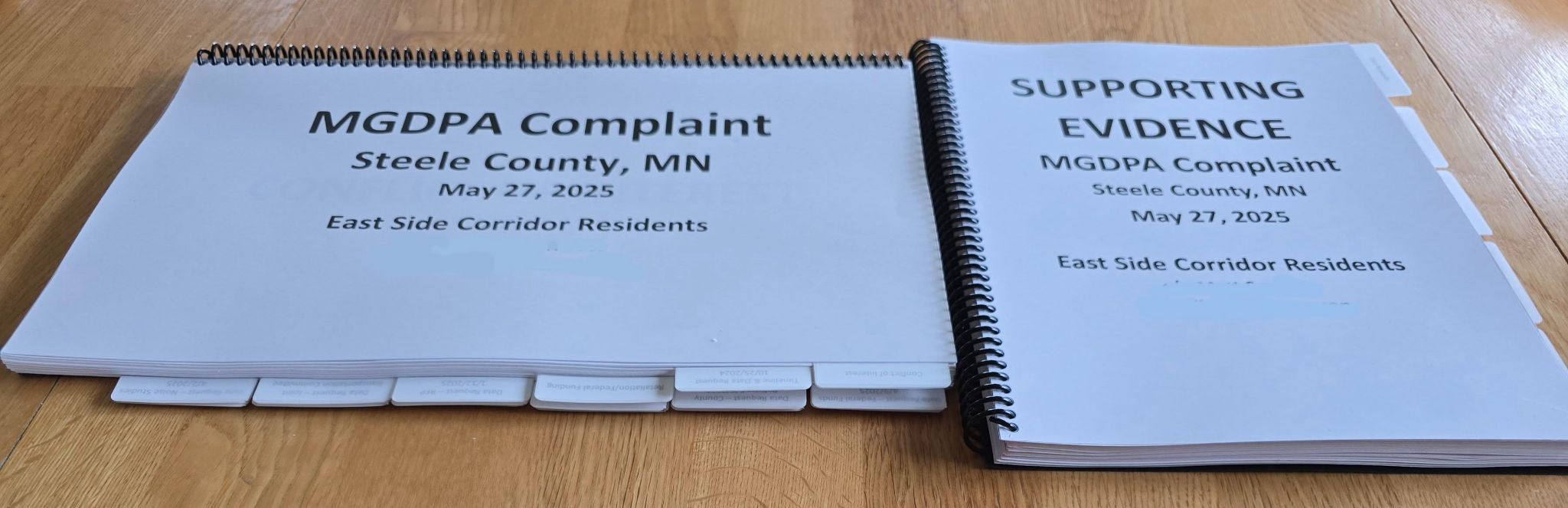
Minnesota Government Data Practices Act (MNGDPA) - East Side Corridor Residents Substantially Prevailed Pro Se
STATE OF MINNESOTA COURT OF ADMINISTRATIVE HEARINGS CAH 22-0305-40882 RULING
January 15, 2026 – Ongoing Public Data Access Failures
As of January 15, 2026, no meaningful public data or access to required viewing software had been provided since March 11, 2025. Substantial portions of previously produced data were missing while in county possession, previously available software access was removed, deadlines for promised data continued to shift by months, data was converted from native formats into .txt files, and data corruption preventing access and use. These conditions prevented residents from meaningfully participating in the EAW public comment process.
November 24, 2025 – Administrative Law Judge Ruling (MGDPA)
An Administrative Law Judge (ALJ) ruled that residents substantially prevailed in their Minnesota Government Data Practices Act (MGDPA) complaint (pro se) against Steele County. The ALJ found that the County committed multiple violations of the MGDPA on numerous occasions, including improper charges for public data, improper responses to lawful data requests, and failure to provide data in an appropriate and prompt manner.
As a result, the ALJ ordered:
The maximum civil penalty
Compliance
Court costs
Selected Findings from the ALJ Decision:
"As a result, what appears to be at issue more than the County’s ordering of responses is the County’s lack of effective or ongoing communication with Complainants regarding their data requests."
"Similarly, mistaken or inappropriate data request responses by County Attorney Jarrett left Complainants without meaningful updates or responses to multiple requests until the hearing on their Complaint. As a result, a civil penalty is appropriate in this case."
"The record demonstrates a pattern of responses inappropriate under the MGDPA. This pattern was a consequence of a procedure that seemingly allowed the Responsible Authority to be, in apparent effect, the only check on his own errors, misunderstandings, or miscommunications"
"As a result of these facts and the record as a whole, the Judge concludes that a civil penalty is warranted. The record establishes multiple violations of the MGDPA and inappropriate responses by the County in addressing the Complainants’ data requests. "
November 7, 2025 – Written Closings Submitted
Owatonna East Side Corridor Residents and Steele County submitted written closing arguments to the Administrative Law Judge.
October 17, 2025 - Hearing Date
A hearing was held regarding alleged MGDPA violations by Steele County. Owatonna East Side Corridor Residents appeared pro se (representing themselves) while Steele County was represented by outside legal counsel. The hearing lasted approximately six hours and was held at the Steele County Administration Building and was open to the public.
The hearing was scheduled across two days to allow for potential testimony by the County Attorney; however, the County did not list the County Attorney as a witness, and the County Attorney was not available for testimony or cross-examination. Although the format for resident testimony had been agreed upon in advance, residents were not permitted to complete their testimony. Despite these limitations, residents presented a detailed and well-documented case.
At the conclusion of the hearing, both parties agreed to submit written closing arguments by November 7, 2025.
Listen to the Hearing Recording
October 10, 2025 – Day 1 of Two-Day Hearing
At the County’s request to accommodate the County Attorney’s schedule, the hearing was divided into two days. On this date, the Administrative Law Judge (ALJ), Owatonna East Side Corridor Residents, Steele County’s retained counsel, and members of the public convened virtually to address pre-hearing matters. No witness testimony was taken; all testimony was reserved for October 17, 2025.
September 15, 2025 - The ALJ Issued Notice of Probable Cause
August 19, 2025 - Residents filed an objection to Steele County’s motion to dismiss.
August 15, 2025 - Steele County Motioned to Dismiss with Prejudice
August 1, 2025 - The ALJ granted a five-day extension
July 28, 2025 - Residents formally objected to a requested extension and offered a five-day extension
July 25, 2025 - Steele County filed a motion requesting a two-week extension
July 18, 2025 - Steele County was formally served, and Ratwik, Roszak & Maloney, P.A. entered an appearance on behalf of the County
June 17, 2025 - The complaint was amended to clarify and narrow the scope of the Minnesota Government Data Practices Act (MGDPA) issues
June 4, 2025 - Steele County was formally notified of the complaint
May 27, 2025 - Owatonna East Side Corridor Residents filed a formal MGDPA complaint and supporting evidence with the Minnesota Department of Administration
Definitions
Finding of Fact and Conclusion
Based on public comments and the recommendation of the Responsible Government Unit (County Engineer / Public Works Director), Steele County must decide whether a project can move forward at all — or whether significant impacts require deeper review or abandonment of the project.
Finding of Significant Impact (FOSI)
This means the project has the potential to cause significant environmental, social, or financial impacts, such as noise, farmland loss, floodplain impacts, financial costs, predetermination, or a combination of these effects.
Possible outcomes include:Preparing a full Environmental Impact Statement (EIS)
Discontinuing the project
Finding of No Signficant Impact (FONSI)
This means the agency claims there are no foreseeable significant impacts and that residents would not be harmed by the project as proposed.
**If the underlying record is incomplete, inaccurate, or biased, a FONSI can be challenged through a petition for an EIS or a formal appeal.
What an Environmental Assessment Worksheet (EAW) Is — and What It Is Not
An Environmental Assessment Worksheet (EAW) is a completed environmental review document prepared by the Responsible Governmental Unit (RGU) to evaluate a proposed project and its potential environmental impacts. Once an EAW is released for public comment, it is considered a complete document—not a draft—and it represents the RGU’s finalized assessment of impacts based on the information it chose to include.
During the public comment period, the EAW itself is not rewritten or substantively changed. Instead, comments are submitted into the administrative record. After the comment period closes, the RGU must review and respond to substantive comments and determine whether the project may proceed with a Finding of No Significant Impact (FONSI) or whether Significant Impacts Exist and a more detailed Environmental Impact Statement (EIS) is required.
If deficiencies, missing analyses, or new information are identified, the RGU may issue clarifications, supplemental responses, or additional environmental review. However, the EAW does not function as a living or evolving draft during public comment, and statements characterizing it as “still a draft” are inconsistent with the MEPA process.